Affichage des articles dont le libellé est document. Afficher tous les articles

7.05.2015

Highbury Park

Below are the two sides of a small piece of paper. One side reveals it is probably a sixth or an eight of a document from the romanian consulate in Antwerp. There are several of such documents (in diffferent states of conservation) in the binder :


On the other side is an adress in London : 


which I read as

S Saperstein
125 Higbhry Park 5
London

very difficult to decypher beneath the line ; "11 Kay" ?

We know from this card that Eisik most probably went to London between 1922 and 1935. What does Internet research on the above name and address reveal ?
I assume that Higbhry is a notation of Highbury.

This brings us to "125 Highbury Park" (Also guessing that the "5 London" on the card stands for N5 today ):

Unfortunatelly I have not been able to look furhter what this adress reveals around the 1930's.

12.19.2013

Association des Juifs en Belgique - Jodenvereeniging in Belgïe

By the decree of november 25th , 1941 all Jews had to register themselves at the  "Association des Juifs en Belgique - Jodenvereeniging in Belgïe" which stands for Belgian Jewish Organization, located Quai du Commerce 18 in Brussels.

I have here the receipt of enrollment of Avram Kahan, dated March 19th 1942. One had to pay (!) 10 Fr for this mandatory administrative step that had as objective to create lists of Jews and prepare deportation.


Interestingly, on the backside of this document, there is in handwriting a list of items that look like a packing list for travel or, more probably, for hiding. It reads (left original in dutch, right the english translation):

1 Laken                     1 blaket
1 Onderbr.                 1 underpant
2 hemden                   2 shirts
1 vervet  (? unsure)
1 hand
2 badd.(ekens)           2 towels
3 lapjes (? unsure)     3 cloths
2 flxxxxx (?)
3 zakdoeken               3 handkerchief


The family story goes that Avram was hidden in Brussels when in August 1942 his parents and brother and sisters were deported.

9.10.2013

Small black notebook

A small black notebook was part of the documents received. It contain some 70 pages, but only a few of them contain notes. The written pages do not follow, they seem randomly chosen, with sometimes 15 blank pages in between.

I here include the pages with notes on them. (UPDATE 11.2015 ; see also this document where some of the people mentionned below reappear)

On this page we see names (Rechinski, Pasternack, Horn, Stern), streets ('Leuwrik' =Leuwerik, Lange kievit) and the mention of '100 Stuk' and '50 stuk'. Stuk means 'pieces'. So this seems like an inventory of number of pieces for certain people at some adress. Note that Pasternack is the last name of Sura.

As the first scanned page, here again names, streets and pieces. Very interesting here for me is the mentionning of first names. Would Vrieda Pasternak, and Refka Pasternak be relatives of Sura. Vrieda and Refka being female names these could be sisters or nieces of Sura. I don't think it would be the mother unless she would be mentionned here with the name of her husband. In that case that means I would be able to go one generation further in the family tree. The 50/100/200 'stuks' or pieces I have no clue what they refer to; it would be something to be counted in ballots of 50...


What first strikes here is that the handwriting is different.Dates in 1935 and 1936. 
On the top row it reads "Electrik betaald tot 1 october 1935" which translates to electricity paid for until october 1st 1935.   
Then "a cont achterstallige huur 400fr 14-10-1935" which means unpaid rent 400fr on 14-10-1935. I have no clue what the "a cont" stands for. In french there is acompte which is an advance payment. It could be the fice sentences starting with "a cont" are the such payments for rent.

Bottom-right there is a fiscal stamp worth 1 Frank with serial 7R-554045. The 1 FR is printed on top which means that the value of the stamp was determined at purchase time.I have found some examples here with serial starting with 0E and dated january 25th 1935. Probably by doing more research on this stamp serial number one could date it more precisely and see f.i. if it was, or not, added at same period than the handwriting.


"bei Mailleg Maileri komt mir ein betraik fon 30fr" It think this is yiddish to say Mailleg ows 30fr.


Would that be a third different handwriting in this notebook ? It is difficult to decypher. I read it as german (or yiddish?) and that Mr Kahan has paid an amount. Dated 10/11/34 ?

8.03.2013

1942 Payments record to Antwerp Gas Company

This simple document is the monthly payment scheme form of the Antwerp Gas Company (Antwerpsche Gasmaatschappij) for the year 1942. It refers to the gas consumption of "Kahan 71 Lange Kievit". The Lange Kievitstraat is a recurring street name in these files.

The payment scheme is documented from January till August 5th 1942. We know that there were 3 razzias in Antwerp in 1942 on August 15th and 16th, and on September 11th.

The empty lines on this document are the exponent of the annihilation of a family.

The fact of going and paying your gas bills like any other citizen and being deported just two or six weeks later (I do not have yet the exact date of Eisik, Sura and children's deportation). What a system has admitted this ?

This may be a detail, but one thing struck me. If we compare m³ consumption (3rd column) we see for instance : December  52m³, January 36 m³, February 36 m³... June 60m³, July and August 40.
I would have expected the winter months to be sensibly higher in consumption if it was for heating purposes. Here in fact the consumption is rather stable so I deduct that heating was done with coal (as in many houses at that time) and that gas was just used for cooking.

7.30.2013

1938 letter to Josepf Rappoport

This is a letter from the Chevrah Torah Synagogue to Josepf Rappoport is dated August 24th, 1938.

The letter raises several questions about places and adresses that either have changed name, or do not exist anymore

The street adress "Lange Russbrug Straat" does not exist today. Either the street name has changed, or there is a spelling mistake in this name. Also I did not find any Synagogue on Highway, London.


Note that the name Rappoport may have also been misspelled from Rappaport, Rapaport or Rapoport.

7.19.2013

Newspaper July 1941

Below a piece of newspaper that I found in between all the more personal papers. The reference to the sinking Saint-Didier ship in Ankara can also be found here, whichallows to date this piece of newspaper to be of the second half of July 1941.

I do not know if this paper was kept for special reason with the other family documents or is maybe just a piece of wrapping or protection for something.


7.17.2013

Photograph of Eizik Hersch Kahan

I have provided Eizik Hersch Kahan's photograph to Yad Vashem database of Holocaust victims.


The undated picture comes from a romanian document and is autographed by the owner.

6.09.2013

Jozef Kahan's last known written words from Dossin Kazerne

I hereby show the letter written on 27.09.1942 by Jozef to "Charlot Dokx" which refers to my grand-mother Charlotte Dockx. 
I already explained the lay-out this document when I published the letter from Sara Schiffer. We see here that Jozef was bound for transport n°12, and held number "130".
The letter was adressed to Lange Kievitstraat 101 in Antwerpen. However, my grand-mother did not live there, I know from family hearsay she lived north of Antwerpen near Schoten. The Lange Kievitstraat is part of the streets that were targetted by the authorities for deportation, in the midst of teh jewish quarter. As one can read on page 26 of this document the Lange Kievitstraat had the most jews deported, thus at the time of writing this letter I do not expect anyone to live there anymore (and there yet). 
Charlotte was married to Jozef's brother, Avram. As a non-Jewish person I guess it was much less dangerous for her to go to this adress and take the mail. Avram was hidden at that time - Jozef knew in some way he could not have the letter delivered to his brother thus combined the person most free of movement and the adress he knew. 

I still need to validate who lived on LangeKievitstraat 101 at that time.

Now about the letter itself.
here is the dutch/flemish text word by word :
"Fruchten en andere levensmiddelen zoals suiker of brood  ?enwarmeflesch met een schoteltje ook confituur en een mes en wat u denkt dat ik nodig heb"

Signed: KAHANJ  Zaal 2
First the english translation :

Fruit and other foodstuff like suggar or bread. ?nd warm bottle with a saucer 
also jam and a knife and what you think that I need.

Signed KAHANJ  Room 2
Now some comments from my side:
The word mes (knife) has been striked through by a pencil of another colour than the writing; this is censorship by the authorities. Jozef was 13 years old, asking for a knife shows so much that this child still thought that some normality would be possible, where children use a knife to cut the bread.
Except the first word "Fruchten" which should be spelled Vruchten there are no grammatical or orthographe errors - not sure today's 13 y. old would write as such.


This letter is the last testimonial that Jozef left to this world. He was death, murdered in Auschwitz, less than 3 weeks later.

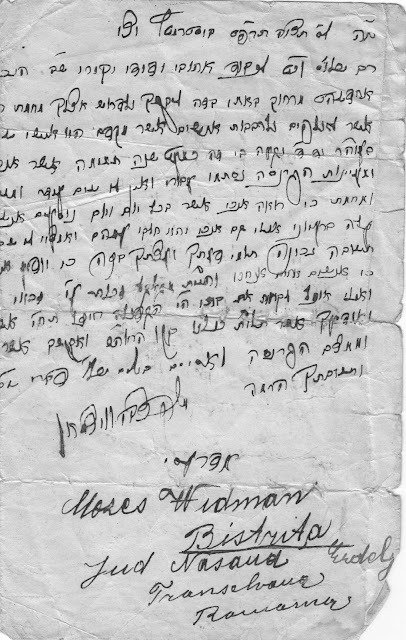
Text needing translation

In my binder was also this letter.


I do not know what it is about. The left border suggests we only have part of the text, maybe half.


Notice that the name and adress at the bottom are in latin letters. This suggest to me that the purpose was that it was also understandable to non jews. It could be that it is the adressee to which the letter should be sent to, but I may be wrong and this may be the signature of the writer sharing his home adress for a reply.

About the adress; Bistrita is a city in the Judet Bistrița-Năsăud in Transylvania. I found this record in the Yad Vashem Central DB of Shoah Vicims 

I wil be thankfull to anyone able to help on the content.

UPDATE: Posting this on Facebook "Yiddish pour les nuls" page I got some interesting feedback about content of this letter :
 -ce n'est pas du yiddish mais de l'hebreu c'est adresse a ''ahouvi yediddi yekiri'': mon amour mon ami mon cher'' ca parle de parnassa : le gagne-pain, je n'arrive pas a tout dechiffrer, tres belle ecriture avec beaucoup de personnalite
 -le mot ''parnassa'' revient par deux fois a la fin le mot ''pessah'' apparait aussi
-envoye a la parashat tetsave tarpass ou tarpat = 1928 cad en fevrier 1928 ce shabat se situe 5 semaines avant pessah
-C'est de l'Hebreu assez déchiffrable. tres beau langage, 6eme ligne: "et les sources (rivieres) de la parnassa ce sont bouchées pour moi"
-ca commence comme ca: ''rav shalom....lihvod ahouvi yedidi yekari''.........merahok baati ....lidrosh etsleha...:: grandes salutaions/shalom adressees a mon ami tres cher......... de loin je suis venu pour te demander/exiger...... peut etre s'agit-il de quelqu'un qui demande a etre rembourse avant Pessah puisque les sources de revenus/''parnassa'' se sont taries devant lui?
-

4.04.2013

Letter from the Home Office, UK

This paper of which about only the upper third remains raises more questions than providing any answers.

click to enlarge

It emanes from the Home Office in London, is adressed to Eizik Kahan and holds a reference number K.10856. It is dated April 28th, 1938.

Today the Home Office defines its missions as (link)
The Home Office leads on immigration and passports, drugs policy, crime policy and counter-terrorism and works to ensure visible, responsive and accountable policing in the UK.
The seal in the middle represents a Union Jack flag around which is written "National Scheme for Disabled Men". Some research on the net learned that this seal was granted to those employers (in this case the Hoome Office) that employed a minimum percentage of disabled men from the first World War.

I have found in Eisik's passport a stamp for a visa to the UK in september 1938. I will come back to this later in another post where I will scrutinize all stamps and dates of the passport.

The object of this letter remains hidden to me. I understand the passport is directed to be returned with an endorsement. That endorsement has a condition attached, but the text is missing.

What was the original request ?
In which (immigration) procedure was this part of ?
What were the UK regulations regarding east european jews in 1938 ?

many questions...

3.23.2013

Scanning finished. Work begins.

Bad weather helping, I got through scanning all the pictures and documents that came with the red binder.


So this is all about family stories on my father's side. My grand-father came from Romania to Antwerp in 1928. He came with his two sisters and parents. A brother was to be born the next year.

After WW-II only my grand-father and one sister survived. The others where deported in 1942 and immediately murdered in Auschwitz.

What I want to achieve with this blog is to share all the research I'll do and the information I possibly get out of the pictures and documents and, as such, testify of a past, of lives and of a tragic destiny. Disseminating this information digitally is a way to prevent that these relics would dissapear or be forgotten.

Putting the documents on the scanner already was revealing names I didn't know, dates ranging from the 1890's till the 1950's and adresses located in Belgium, Romania, England and the US. I will label posts to this blog trying to refer to names, dates and locations in order to ease the reading and finding linkages between documents.